FreezePruf™ - A Quick Summary
I ended my winter 2010 evaluation of Lycoris hardiness with the following statement, “This product will probably be applied again next year in the hopes of evaluating under more normal circumstances and with a properly timed second application.” The “product” referred to was FreezePruf™, an organic solution sprayed on winter plants, touted to improve plant cold hardiness by as much as 9°F.
The winter ending 2011 was in no way a normal winter, instead offering up winter lows that matched the record for our area. I also did not follow my own advice, but modified it. I still sprayed the first application of the solution at the appropriate time, but, shortly after, I covered my Lycoris in Reemay, which is only supposed to protect plants by another 2°F or so. My logic was to provide better protection than I had the year before, especially by offering a frost barrier, where I had only sprayed once, and avoid having to spray again in January/February. Little did I expect the temperatures we would see.
Thankfully, with those temperatures also came snow, which acts as a good insulator. This protected the bulbs, themselves, from actually getting as cold as outside air temperatures, but I was not sure what would happen to the foliage separated from the snow only by a thin layer of Reemay.
For the most part, things went really well. Lycoris xalbiflora performance was disappointing, though, as the foliage did not survive well, even though it performed sufficiently well the year before down to 0°F. Lycoris aurea, treated differently, still sprayed once, but using heated plastic tunnels instead of Reemay, just could not handle the cold, and performed the same as the previous year. This time the heat lamps did not fail, but could not compete with -15°F. Under the Reemay, L. ‘Cherry Blossom Pink’ and L. straminea did not perform well, either. Otherwise, Lycoris foliage performance was as good or better than the previous year, that year’s results of which can be reviewed in detail in the article, “A Practical Evaluation of FreezePruf™“.
My hopes are that this winter will behave more “normally", but whether or not it does, due to the extreme nature of the past two winters, I am convinced FreezePruf™ must become a standard part of my winter Lycoris maintenance program. Thanks to all those who have worked to develop such a product, as it has really served me well in this unique situation.
Nursery Trials & Forward Thinking!

What a year it has been! With this past winter we saw record matching lows, reaching down to -15°F!! If that wasn’t enough, this spring we saw 13″ of rain in a span of 10 days!!! And, if THAT wasn’t enough, this summer we experienced a 6 week drought with many, many days over 100°F, with the highest reading being 107°F (IN THE SHADE)!!!! Ah, but the things we get to learn through trial.
So, what did I learn from record matching lows?
- That FreezePruf™ will definitely remain a part of my winter maintenance schedule. I will be posting about this season’s anecdotes shortly.
- That some flower bulbs are just WAY hardier than common wisdom dictates. I was thrilled to see survival and thriving spring growth in species I never imagined could survive.
And, how about all that spring moisture?
- Well, the main thing I learned was that it is best to keep up with weed control as much as possible.
- That I may want to look into some simple, organic fungus and bacterial controls to encourage flower bulb foliage health. This is an issue faced to one degree or another, even under normal moisture conditions.
Finally, were there lessons learned from intense summer heat and drought?
- This is a good reason to have a permanent irrigation system in place, though, under normal circumstances, irrigation is not all that important for most flower bulbs.
- Wear a HAT, Crazy Man!!!
I have not been promoting sales aggressively for about three years, now. The bulk of my business, in years past, had been through dormant import sales, and that avenue of marketing had become untenable. So, I watched my nursery to see how it would perform, since a number of species were only in the nursery as leftover stock from unsold dormant import inventory. The last few years have brought some very extreme weather conditions which have been a true test for hardiness and bulb durability in our area. I have been encouraged with that success.
I am also encouraged by how well some of those products have appeared to increase in the beds. This will lead to some mass diggings, dividing and re-plantings over the next couple of years, and this should make some of my bulbs available at lower prices for short periods of time. I have the parts received for repairing my bulb digger, so I’m all set to get digging!
Due to these circumstances, I have been actively marketing again at a level that will allow me to keep up with requests. This has me looking toward the immediate future as a period of slow growth and added nursery improvements to facilitate efficiency. I hope you will also take note that I do have a presence on Facebook. Please click the image and give us a “Like".
I wish to give my heartfelt thanks to those who have remained loyal customers through my lack of public communication. Not all trials are bad for us. They provide information to help with adaptation or making improvements helping folks learn and grow. It’s time to grow forward! 
Improving Winter Hardiness Of Winter Foliage Lycoris
Sometime in the summer of 2009, I was made aware of a new product coming to market, offered under the label, “FreezePruf™“, which was touted to be able to protect, by a difference of over 9°F, plants susceptible to winter damage. As an example, by definition, if I was growing a plant that would receive cell damage starting at 32°F, the use of this product would protect the plant from the same damage down to under 23°F. Well! Now, I thought to myself, “Wouldn’t it be great if this product really works and could protect some of my winter foliage Lycoris from significant winter injury?” I decided to order a gallon of this product, enough to make 4 gallons of solution, and test it on a number of my small Lycoris plots this winter. Little did I know our region of the country would be the recipient of some of the coldest temperatures we have seen in 15 years. But, that’s getting ahead of the story.
The detailed report can be read under the title, “A Practical Evaluation of FreezePruf™“, in the “Growing Guide” section of the Bulbmeister.COM website. The information will include generalized temperature data and environmental conditions, as well as the procedure followed. Additionally, 14 other plots are featured.
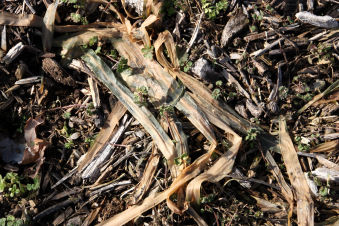
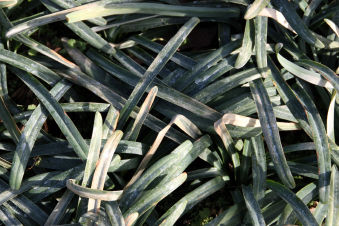
Following are images and descriptions of the worst and best performing accessions in the study. Photographs and evaluations were taken on January 18, 2010.
WORST CASE |
BEST CASE |
OUCH! This most tender member of the Lycoris clan proved it needed far more than a spray protectant to survive. Foliage was completely burned back. This plot was in open ground in full sunlight. |
This open ground plot in full sun received minimal damage, one of the most impressive subjects in the trial, with foliage even more upright than other plots. Please note that the residue of the first treatment is still obviously present on the foliage. |
CONCLUSIONS
Realizing that this is only a practical, subjective study, I believe FreezePruf™ deserves further evaluation by myself as a nursery grower. Based upon the expected behavior of the Lycoris radiata group and L. xalbiflora, I have noted what appears to be significant protection from very drastic low temperatures, not normally recorded for this area of the country. Additionally, a proper application to the underside of the foliage was not feasible, nor was the scheduled second application possible before the lowest temperatures were observed. An additional application was applied to surviving plots on January 18th after the photographs were taken. This product will probably be applied again next year in the hopes of evaluating under more normal circumstances and with a properly timed second application.
Indian Summer
The year’s activities have been intentionally slowed down at Bulbmeister.COM, but, nature, it seems, “decided” to make things go even slower in the months of September and October. The rain seemed never to cease, making it difficult to even mow, much less prepare the nursery for winter time or dig bulbs for customers. Well, what a refreshing November we are receiving so far! Temperatures have been warmer, and we’ve had mostly sunny weather all month.
Now, it is time to get settled in for the winter. Last orders for immediate shipment will be accepted through the end of the month, although the list remains open through the winter, with products being shipped in the spring. I have started what should be the final mowing of the property for the season, and now is probably a good time for me to bring in bulb pots for winter protection. If I’m lucky (that really translates to “industrious"), I will finish the winter greenhouse and get started on my non-business related apple orchard deer fence.
The fall foliage this year was at it’s best, and I plan to upload some images of autumn to my business page on Facebook. These particular images will not necessarily be flower bulb related, but I’ve already posted to that page some beautiful images of Lycoris in bloom. I would be honored if you would visit the page and even become a fan if you, too, are a Facebook user.
Now is a good time to finish up fertilization and mulching of flower bulb beds for the winter. I will be trying out a brand new product, FreezePruf, this winter to see how it protects my fall foliage Lycoris. Reportedly, it is supposed to protect foliage by a differential up to 9.4°F. In other words, if your foliage normally gets damaged at 30°F, the applied product may keep your foliage from freezing all the way down to 21°F. I’ll try to report on it this spring.
Additionally, this summer, late, deer started foraging heavily in my nursery, chewing Crinum and Hemerocallis, among other categories, down to the nub. I ordered a product called Deer Scram which claimed to repel deer and rabbits for up to two months. I’m very happy to report the product lasted at least six weeks, keeping the deer away, even through several rains. It’s a 100% natural, organic product, but a bit expensive in my budget. With that in mind, it’s active ingredients being dried blood, garlic, white pepper, and cloves, I’m going to try some experiments next season and see if I can’t make my own for much less. That said, I am very pleased with the product and it’s claims.
As a final note, if I don’t post again before then, I want to wish everybody in the U.S. a very Happy Thanksgiving! May you be blessed with family, friends, and/or your favorite things and activities surrounding you.
Plant Breeding as a Hobby
 A visitor inquired about a good source for learning the basics of plant breeding. Since I could not think of a popular book right off of the top of my head, I did an internet search and found a site sponsored by the University of Illinois that should provide all the basics one might need for learning the art of plant breeding.